
What to Ask Before You Hire a Website Developer
The questions to ask before signing with a website developer: live work, hosting in Iran, domain ownership, support after launch and a free demo.
 Habib S. · Ldora

Almost every week I talk to a business owner who already paid for a website and now can't find the admin password, sees the site break on a phone, or can't reach the person who built it. The trouble usually started on day one, in a meeting where the right questions were never asked.
I build websites and business software, such as the online ordering system for Cafe Barama and the Sepehr POS for a supermarket. Here are the questions I suggest you ask anyone before you sign, including me.
Ask for live work, not slides
Screenshots are not enough. Ask to see a site that is online right now and used by a real business every day. Open it on your own phone, tap around and judge the speed yourself.
When I talk about Cafe Barama, I say exactly what it does: online ordering, calories, protein, carbs and fat for every dish, a cart that totals the meal's nutrition, a kitchen screen and a courier app. There is a demo video on the Barama page. Expect the same level of detail from anyone you hire.
- Which of your projects is in use today?
- Can I speak to that business owner?
- Which part did you personally build?
Will it work in Iran and on a phone?
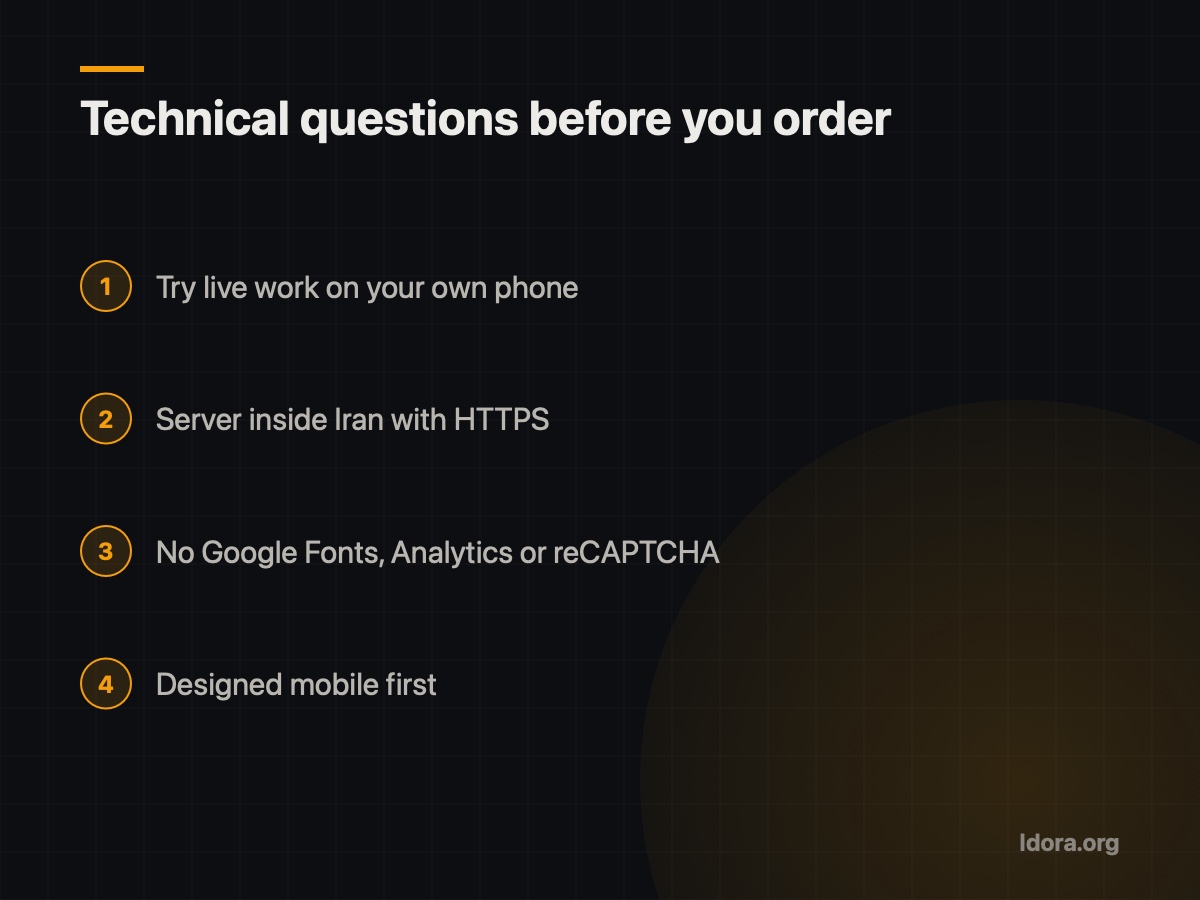
Many sites look great on the developer's laptop and load slowly, or only half load, on a customer's phone over an Iranian connection. Most of your customers will see your site on mobile, so it should be designed for the phone first.
Also ask whether the site depends on foreign services. Google Fonts, Google Analytics or reCAPTCHA can slow pages down or stop forms working under filtering. My sites run on a server inside Iran with HTTPS, with fonts hosted on the same server and none of those services; even the demo-request form notifies me by SMS.
- Where is the site hosted, and does it use HTTPS?
- Does it rely on any foreign fonts, scripts or services?
- Is it designed mobile first?
Who owns the domain, passwords and code?
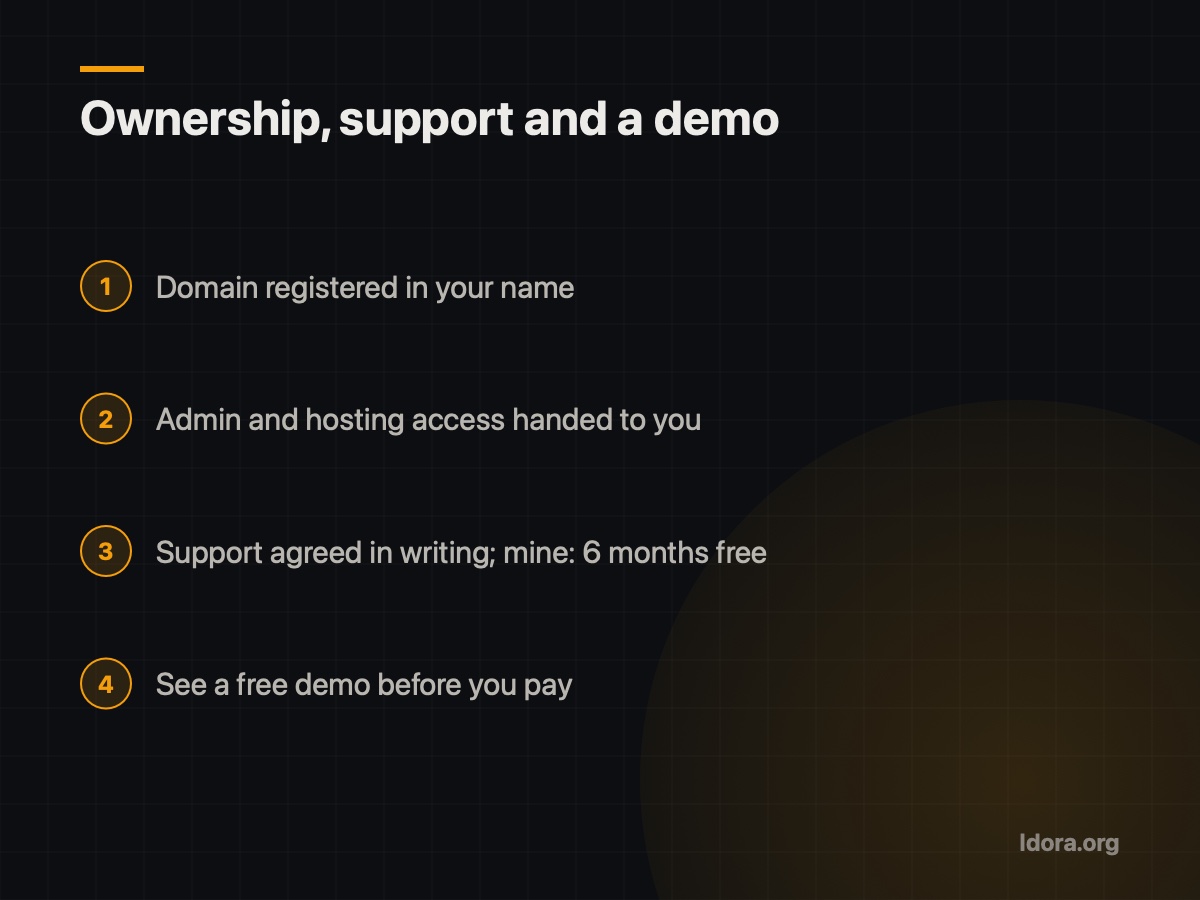
This is the part people forget. The domain should be registered in your name, not the developer's. You should also hold the admin and hosting access, even if you never use it.
If you ever part ways with the developer, you must be able to hand the site to someone else. So ask, before work starts, exactly what will be handed over at the end.
What happens after launch?
A website is never really finished. Prices change, products are added, new staff need to learn the admin panel, and some problems only show up in daily use. When Sepehr POS replaced the shop's old software, a lot of the work happened after installation, during the first days of real sales.
That is why my projects include six months of free support. Ask any developer:
- How long is support after launch, and what does it cover?
- If the site goes down, how do I reach you and how fast do you reply?
- How are small later changes, like a new page, handled?
See a demo before you pay
The best way to judge software is to use it before paying. A real demo lets you place a few test orders, look at the reports and let a staff member try it. If your staff are confused in the first ten minutes, they will likely stay confused.
Ask for a demo close to your own business: online ordering and a kitchen screen for a café, barcode scanning and printed receipts for a shop. I always show a free demo before anyone decides.
Checklist before you sign
- I have seen live work and tried it on my own phone
- I know where the site is hosted and that it uses HTTPS
- It does not depend on foreign services that break in Iran
- The domain is in my name and all access will be handed to me
- Support length and scope after launch are agreed in writing
- I have seen a demo, and my staff have tried it, before paying
You are welcome to ask me every one of these questions. See the demo first, then decide: request a free demo.
Want something like this?
Tell me about your business
More guides

Mobile-First: Your Customers See Your Site on a Phone
For most local businesses, the customer's journey starts on a phone. Here is what mobile-first design means and how I apply it in my projects.
Read
SEO Basics for a Small Business in Iran
Why can't customers find your business site on Google? Simple SEO basics: page titles, descriptions, real content and technical points that matter in Iran.
Read
Kitchen Screen and Courier App: Where an Order Goes After Payment
After the customer pays, an order should reach the kitchen and then the courier without anyone rewriting it. Lessons from building Cafe Barama's kitchen screen and courier app.
Read