
Running a Building Without a Manager: Rota, Votes, Accountant
What I learned building an app for a 9-unit building with no manager: a weekly duty rota, votes on big costs, and an accountant who only pays bills.
 Habib S. · Ldora
In many apartment buildings, being the building manager is the job nobody wants. One person carries everything for years, burns out and steps down. After that, the stairwell light stays broken for weeks, nobody is sure where the monthly charges went, and every big repair turns into an argument in the residents' group chat.
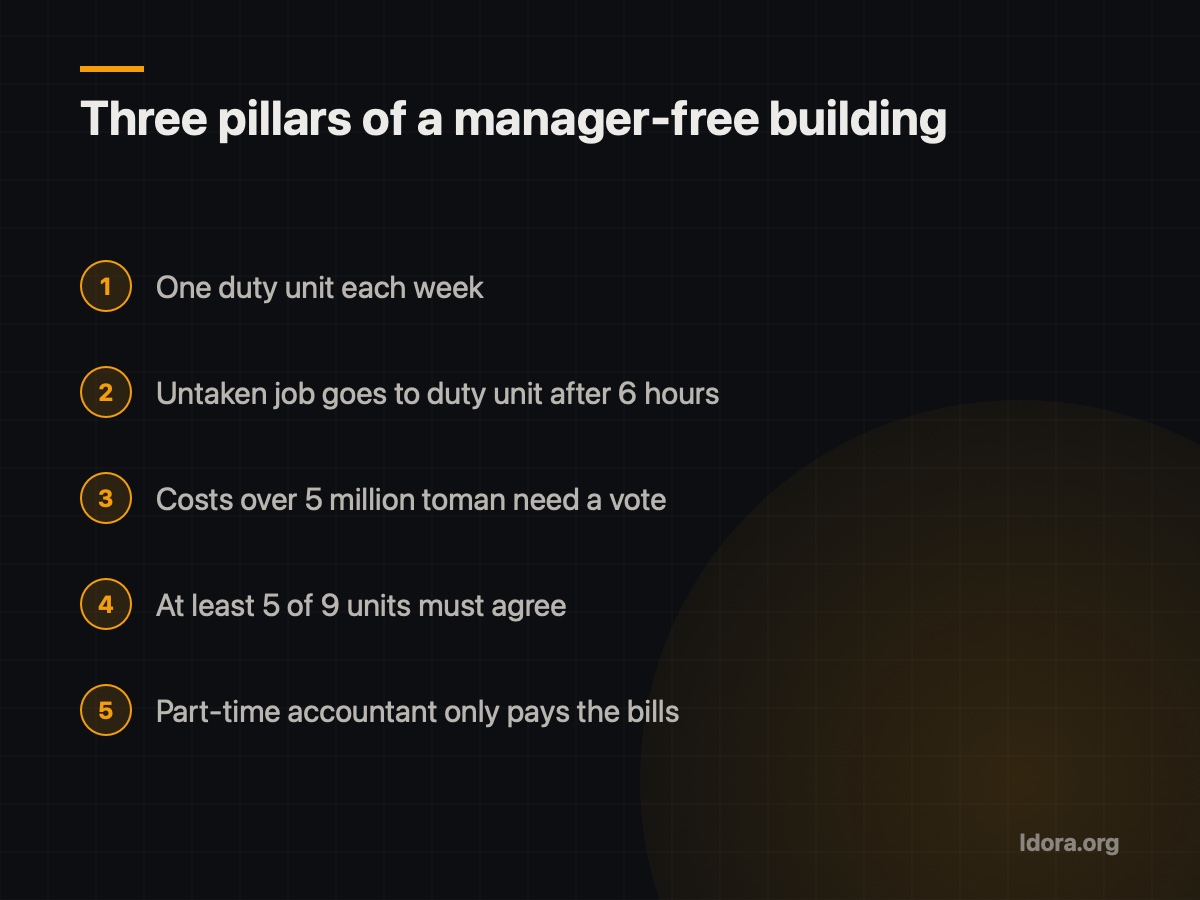
I have been working on an app for a 9-unit building that has no manager at all. The idea is not to replace the manager with someone else, but to share the work and make every decision visible. The app is still a prototype, and residents are using it and giving feedback. Here are the three pillars of this model: a weekly rota, votes on costs, and a part-time accountant.
Why "one manager for everyone" breaks down
When everything depends on one person, the same problems keep coming back:
- Burnout: chasing repairmen, collecting charges and answering everyone is a part-time job, usually unpaid.
- Mistrust: when only one person sees the accounts, questions come up even if they do everything right.
- Orphan tasks: when no one is clearly responsible, everyone assumes someone else is handling it.
The answer we reached with the residents is simple: take turns, spend money only by group vote, and give the bookkeeping to someone whose only job is paying bills.
A weekly rota: one unit on duty each week
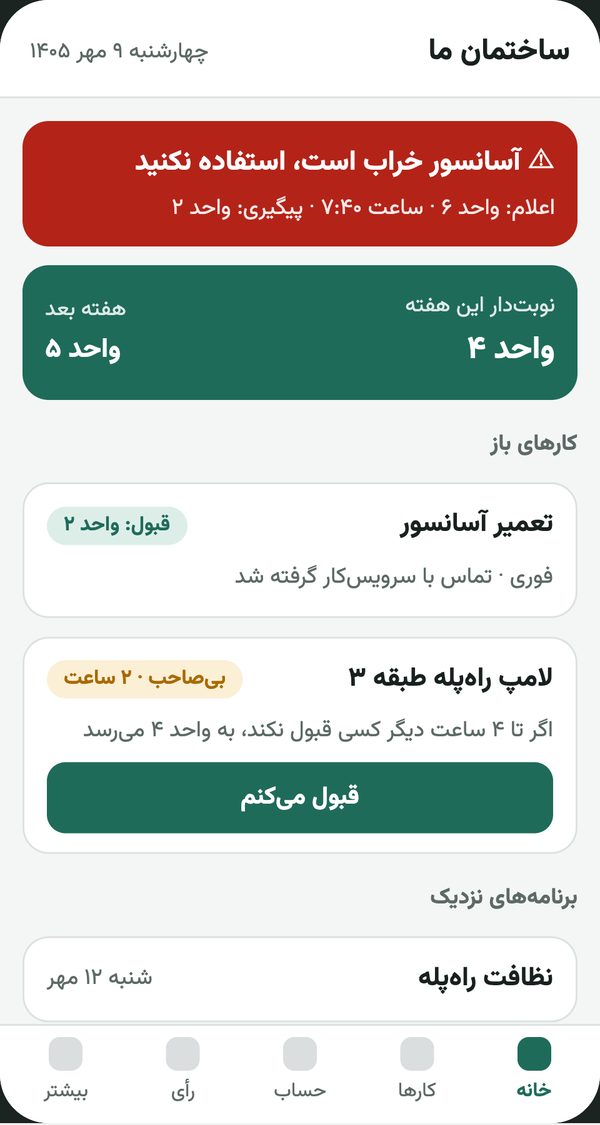
Each week, one of the 9 units is the duty unit. The app rotates this automatically, and everyone sees on the home screen whose turn it is.
Building jobs, like replacing a bulb, calling the lift technician or tracking down a leak, are posted in the app. Any resident with time can pick one up. But if a job sits for 6 hours and nobody takes it, it goes to that week's duty unit automatically. This one small rule means no job is left without an owner, while the load never sits on the same person forever.
For emergencies there is a one-tap urgent alert: someone stuck in the lift or water coming through a ceiling, and every resident knows at once. Next to it is a repair-contacts phone book, so nobody has to ask the group "does anyone have the electrician's number?"
Votes: no big spending without the group
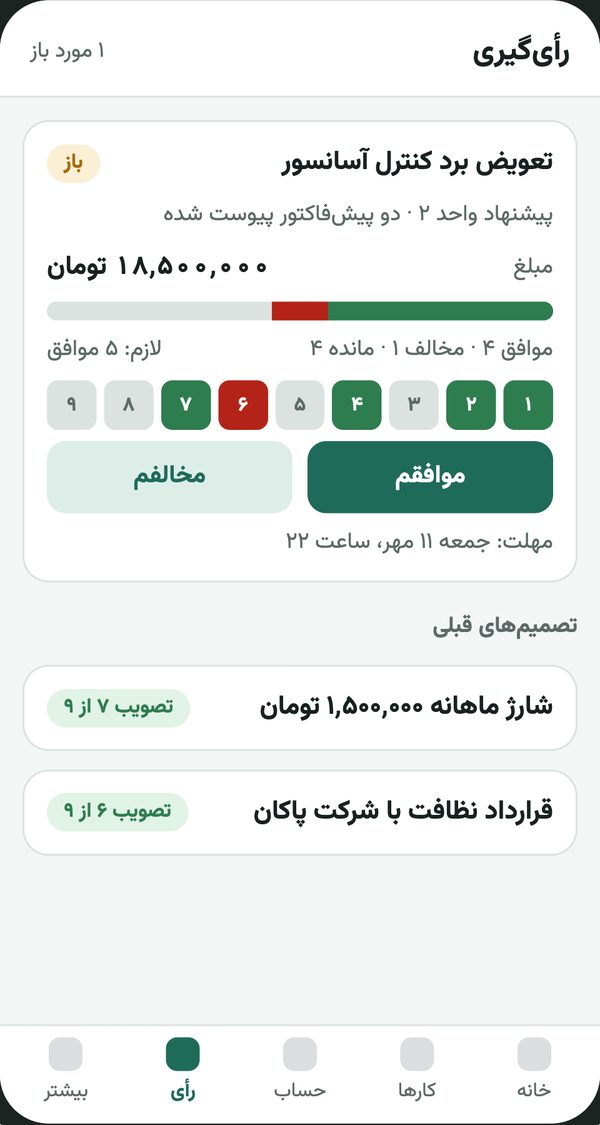
Most building arguments are about money, so this model has one clear rule: any cost over 5 million toman needs a vote, and at least 5 of the 9 units must agree.
Whoever proposes the cost enters the description and amount in the app. Each unit votes, and everyone can see how many approvals have come in. Nothing is paid until the vote passes. The discussion moves out of the group chat into one organised place, and small everyday costs still go ahead without a vote so the building does not grind to a halt.
A part-time accountant: pays bills, makes no decisions
There is a part-time accountant, but the role is very different from a manager. The accountant does not decide what gets bought or repaired; they only pay the bills and approved costs.
That separation matters. The people who decide (the residents) are not the person who moves the money (the accountant). Every job in the app, from the first report to the accountant's final payment, can be followed step by step, and residents can see which units have paid their monthly charges.
Where to start
You do not have to change everything overnight. Start with the rules, not the software. Once residents agree on the rota and the spending limit, a simple app just makes those rules easy to follow and easy to check. The biggest lesson from residents' feedback so far: keep it very simple. The home screen should answer three questions at a glance: whose turn is it, what is open, and is there an emergency?
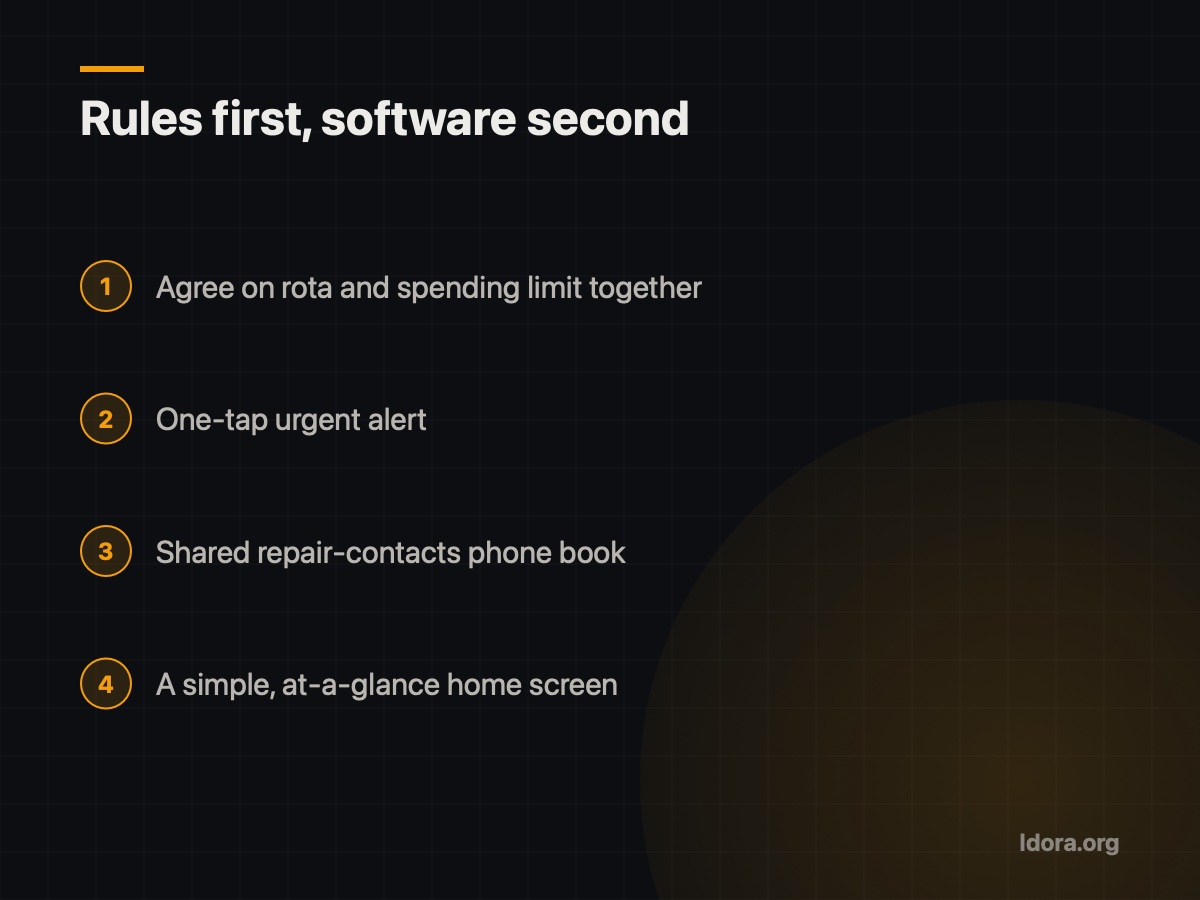
Checklist
- Hold one meeting with every unit about the no-manager model.
- Set the order of the weekly duty rota.
- Pick a deadline after which an untaken job goes to the duty unit.
- Agree on the cost limit that needs a vote and how many votes it takes.
- Choose a part-time accountant just for paying bills.
- Collect trusted repair contacts in one shared phone book.
To see how this works in practice, have a look at the building management app. If your building has its own needs, I would be glad to set up a free demo so you can try it before deciding anything.
Want something like this?
Tell me about your business
More guides

Scale-Label Barcodes: How a Supermarket POS Reads Weight and Price
What a scale label holds, how a POS reads weight and price with one scan, and what to check before going live, from my work building the Sepehr supermarket POS.
Read
Café Staff Attendance and Payroll: What to Track
What a small café should record every day so month-end staff payroll closes without mistakes or arguments, based on my work for Cafe Barama in Shiraz.
Read
Android App Without Google Play: Ship an APK From Your Site
How to deliver a signed Android app (APK) to your customers straight from your own website, without Google Play, based on real experience with Cafe Barama.
Read