
Café Staff Attendance and Payroll: What to Track
What a small café should record every day so month-end staff payroll closes without mistakes or arguments, based on my work for Cafe Barama in Shiraz.
 Habib S. · Ldora
At the end of every month, many café owners go through the same routine: open the attendance notebook, scroll through group chats to see who swapped which shift, hunt for the note about an advance someone took, and then sit down with a calculator. It costs hours, and sometimes ends in an awkward argument about whether someone really worked that Tuesday.
I saw this up close at Cafe Barama in Shiraz. While building the café's online ordering system, I added a staff section next to it: attendance, shift planning, advances and month-end payroll, all in Persian (Solar Hijri) dates. Here is what I think a small café actually needs to track to keep payday calm.
Why notebooks and chat messages fail at month-end
A paper notebook works fine for the first week. Then real life happens:
- Someone arrives late and agrees to stay later that night.
- Two people swap shifts and only mention it in the group chat.
- Someone takes an advance mid-month, and only the two of you know.
- Someone is on leave and a colleague covers for them.
Each of these ends up in a different place: the notebook, a phone, your memory. At month-end you have to piece them together, and that is where mistakes happen. The hard part is not the maths. The hard part is that the information is scattered.
The four things to record every day
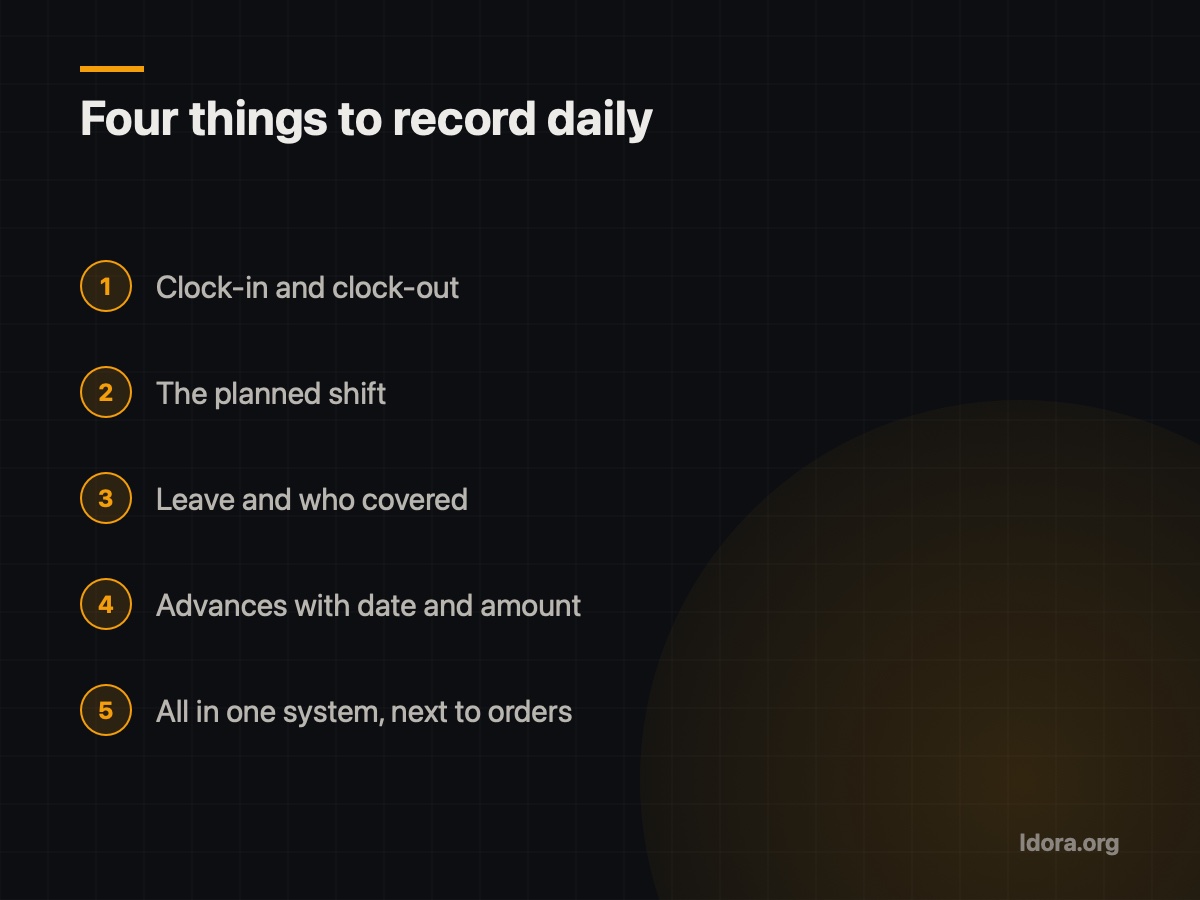
A small café does not need a full HR system. Four things are enough, as long as they are recorded every day, in one place:
- Clock-in and clock-out. Who worked, which day, from when to when. Everything else is built on this.
- The planned shift. Who was supposed to work. When the plan sits next to actual attendance, swaps become obvious.
- Leave and cover. If someone was absent, was it leave or a no-show, and who covered?
- Advances. Any money paid mid-month, recorded with date and amount on the same day, not from memory at the end.
At Barama all of this lives inside the same system that runs orders and the kitchen screen. There is no separate staff app to install, and nobody has to check several places.
Persian dates matter more than you think
Most off-the-shelf attendance tools are built around the Gregorian calendar, or only display Persian dates on the surface. But payroll in Iran closes on the Persian month, with its own month lengths and holidays.
When the system works in Persian dates from the ground up, "end of month" means exactly what you and your staff expect. The Mehr report is Mehr, not a Gregorian range you have to translate. Barama's month-end settlement works this way, and that one detail removed a lot of confusion.
A month-end settlement nobody argues with
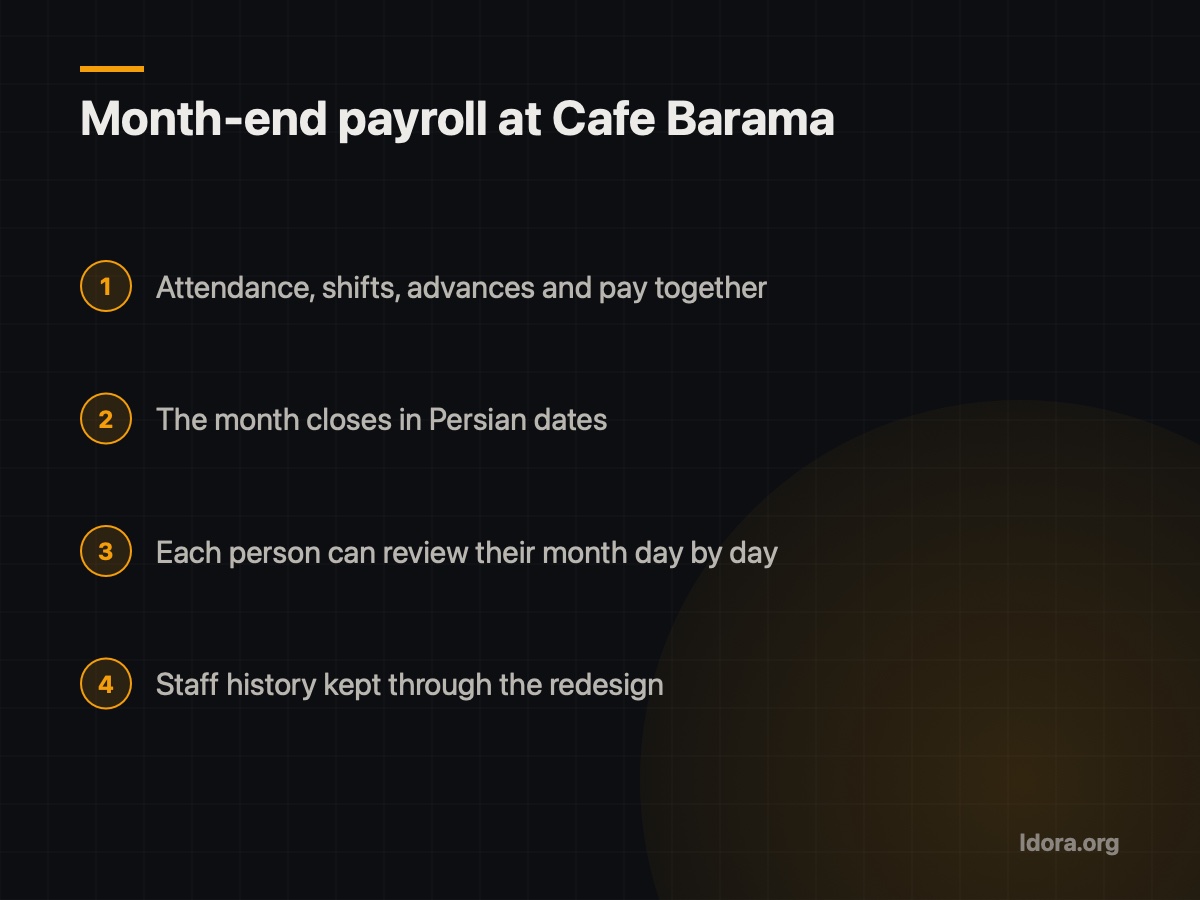
When the daily records are right, settling the month is no longer an evening's work. For each person the system adds up the time worked, what they earned under the café's rules, the advances they already received, and what is left to pay.
More important than speed is transparency. When someone has a question, it is no longer my word against theirs. We can open the month day by day together: you came in here, left at this time, took an advance on this date. Most disagreements end there, because both sides are looking at the same record.
Staff data also has to last. When you upgrade or redesign the café's system, shift history, pay and advances must not be lost. I treated this seriously during Barama's redesign, because those records are part of each person's work history.
Where to start
You do not need everything on day one. Start with clock-in/out and advances; those two fix most disagreements. Once everyone is used to it, add shift planning and leave.
If you already have an online ordering or POS system, keep the staff section in the same place, so there is one login for everything. You can see the full combination on the Cafe Barama page: menu, ordering and kitchen through to staff and payroll.
Getting started checklist:
- Write down your pay rules (overtime, leave, cover) and review them with staff
- Record clock-in and clock-out daily, in one place, starting this week
- Record every advance on the day, with date and amount
- Enter the shift plan before each week begins
- Record leave and cover separately from absence
- Make sure reports close on the Persian month
In short
Payroll for a small café is not complicated; scattered information is what makes it hard. Record attendance, shifts, leave and advances every day, in one place, in Persian dates, and month-end becomes opening one report and paying.
If you would like to see how this could work for your café or restaurant, request a free demo. You see it first, then decide.
Want something like this?
Tell me about your business
More guides

Android App Without Google Play: Ship an APK From Your Site
How to deliver a signed Android app (APK) to your customers straight from your own website, without Google Play, based on real experience with Cafe Barama.
Read
Switching Supermarket POS Without Losing Data
What I learned moving 6,327 products from a supermarket's old POS to a new system: exporting and cleaning data, testing scale labels and checking customer credit.
Read
Building a Website That Keeps Working in Iran
Why many sites load slowly or break in Iran, and how a local server, HTTPS and no foreign services like Google Fonts or reCAPTCHA keep yours working.
Read