
Why a Café Menu Should Show Calories and Protein
What I learned building Cafe Barama's menu: showing calories, protein, carbs and fat per dish, totalled in the cart, builds customer trust.

If you run a healthy-food café, you hear the same questions every day: "How many calories is this?" "How much protein does it have?" People who train, follow a diet, or simply care about what they eat want numbers, not just a nice description. When the menu can't answer, either your staff answer it again and again, or the customer orders with a doubt in mind.
When I built the online ordering system for Cafe Barama, a healthy-food café in Shiraz, we decided from day one that nutrition would be part of the menu itself, not a separate sheet on the wall. Here is why I think it's worth doing and what I learned along the way.
Healthy-food customers decide with numbers
Words like "light", "fit" or "high-protein" are easy to write, and every café writes them. What builds trust is a clear number: calories, protein, carbs and fat.
At Cafe Barama every dish shows those four values right in the menu. Nobody has to ask or guess.
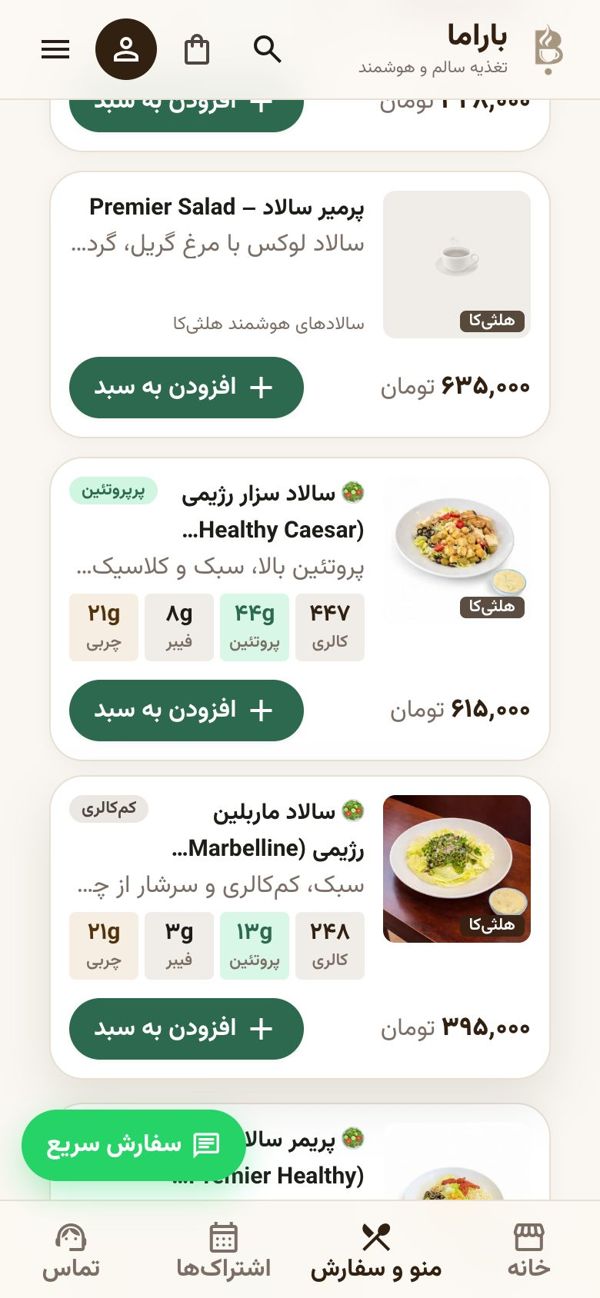
The effect is direct:
- Customers decide faster because the information is already there.
- Staff spend less time on repeated questions.
- The menu matches the promise the café makes: healthy food.
A single dish is not enough — the whole meal matters
People rarely order one item. It's a main dish, a drink, maybe a dessert. Someone tracking their daily calories or protein wants to know what the whole meal adds up to.
So in Barama's cart, the nutrition of every item is added together. Before paying, the customer sees the total calories, protein, carbs and fat of the order and can swap or remove something right there.
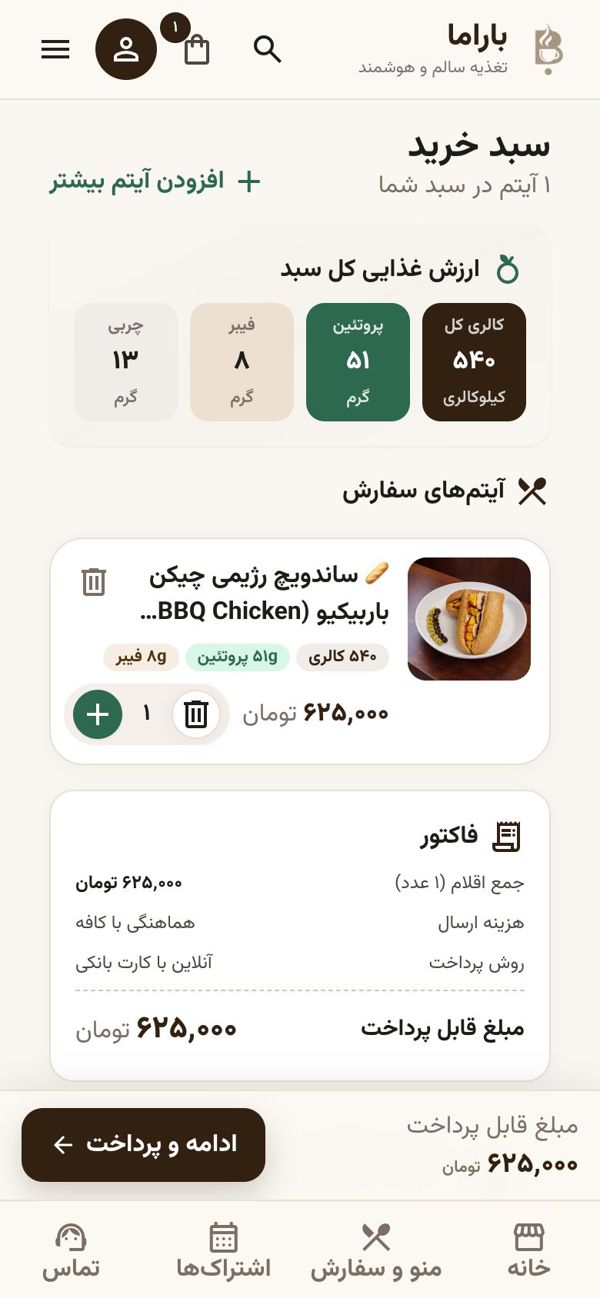
For me, this is the difference between a menu that has information and a menu that is actually useful.
The numbers must be correct and consistent
Showing numbers is a responsibility. Guessed or inconsistent values destroy the trust you wanted to build. A few rules I follow:
- One source per dish: calculate nutrition once from the real recipe and store it in the system.
- Stay in sync with the kitchen: if a recipe or portion changes, the numbers change too.
- Fixed units: calories, and grams for protein, carbs and fat — the same everywhere.
- Edit in one place: the menu, the dish page and the cart should all read from the same data. Keep the menu in several places and one of them will fall behind.
Nutrition is part of your brand
For a café that sells itself on healthy food, showing nutrition isn't just a feature; it's part of who you are. The same data appears on the home page with today's dish, on each dish page, and in the Android app that Barama's customers download straight from the café's own website.
You can see the full project on the Cafe Barama page at Ldora.
Where to start
You don't need everything on day one. Start with your best-selling dishes, get their numbers right, then complete the rest. What matters is that the system has a proper place for this data from the start, so you don't rebuild later.
Checklist
- Does every dish have a fixed recipe and portion size?
- Are calories, protein, carbs and fat calculated from that recipe?
- Are the numbers stored in one place that every page reads from?
- Can customers see the total nutrition of their order before paying?
- Is someone responsible for updating numbers when a recipe changes?
- Is the menu clean and readable on a phone, where most people order?
Closing
Showing calories and protein on a menu isn't complicated, but done well it makes ordering easier and builds trust. My experience with Cafe Barama is that it becomes truly useful when it sits next to every dish and adds up in the cart.
If you run a café or restaurant and want to see what a menu like this would look like for you, request a free demo. You see it first, then decide.
Want something like this?